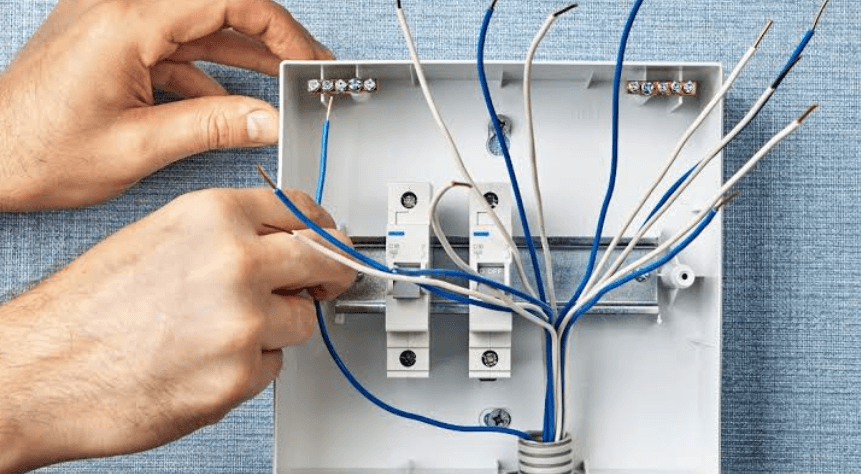
Start with the answer. In a Memphis area house wired before the mid 1980s, smart lighting is a wiring project first and a shopping trip second. The wall switch is the obstacle, not the app. Most of those boxes were built to interrupt a single hot conductor and nothing else, which leaves the small computer inside a connected switch with no steady power to run on. Homeowners in Arlington and Eads find that out the same evening their new dimmers arrive, and it is why the electricians arlington tn families call for a lighting upgrade ask what year the house went up before they quote anything. That question is not a stall. It decides whether the work takes an afternoon or most of a week.
Lighting Is A Small Share Of The Bill
Set the expectation before the money goes out. Federal energy data puts the average American home at 10,791 kilowatt hours a year, roughly 899 kilowatt hours a month, and heating, cooling and the water heater swallow most of it. Lighting is a thin slice of what remains, thinner still in a house that already runs LEDs everywhere. A shelf of connected bulbs barely changes a bill on its own.
The rate is worth knowing anyway. Tennessee households paid an average of 14.94 cents per kilowatt hour in April 2026, according to the Energy Information Administration’s Electric Power Monthly, which is a fair bit under what most of the country pays. Run the arithmetic on one old 60 watt bulb burning six hours a night and you land near $1.60 a month, against something like 25 cents for the LED that replaces it. The meter does not care how clever the app is. It counts hours, nothing else.
Control is where the savings actually live. A homeowner off Airline Road counted nine fixtures burning from dusk until bedtime in a hallway nobody was sitting in. Two occupancy sensors and a scheduled exterior circuit cut that runtime by more than half, and she never changed a single bulb. That is the pattern we see on most jobs, and it has very little to do with the brand printed on the box.
Old Switch Boxes Rarely Carry A Neutral
Here is the mechanism in plain terms. In a lot of older ranches the power reaches the light fixture first, and only a pair of switched conductors drops down the wall to the box, so the switch is nothing more than a gate on the hot leg. An ordinary toggle is perfectly happy with that arrangement. A connected switch is not, because its radio and its processor draw current even while the light is off. The case we see most often is a box holding two conductors, no white bundle at the back, and a homeowner standing there with a smart dimmer that wants three. Fixing it means pulling new cable, or engineering around it.
Example scenario for one switch location in a 1980s Arlington ranch, showing typical parts ranges rather than quotes.
| Approach | Typical Parts Cost | Wiring Work Involved |
| Smart bulbs on an existing toggle | $8 to $20 per bulb | None, but the toggle has to stay on |
| No neutral smart switch with a bypass | $45 to $80 | Bypass module wired in at the fixture |
| Relay module tucked behind the fixture | $30 to $60 | Attic or fixture access to reach the box |
| New cable pulled to the switch box | $25 to $50 in materials | Fishing the wall cavity, then patch and paint |
None of those four is the right answer everywhere. Bulbs are the cheapest and the most fragile, because anyone who flips the toggle off strands the whole system, and guests always flip the toggle. A bypass module is the workhorse of the retrofit and only misbehaves on very low wattage LED loads, which is a real limit worth checking against the lamps you already own. Pulling fresh cable is the clean fix, and in a one story house with a walkable attic it is often no worse than the bypass (the drywall patch is the part everybody remembers). That spread of options is exactly why the electricians Arlington TN homeowners hire will walk the house before putting a number on the work.
Three way hallways add their own wrinkle. The traveler conductors running between two switch locations do not always deliver what a second device needs, so one location becomes the smart switch and the other gets a companion device wired to match. Dimming carries a separate trap, since plenty of budget LED lamps flicker below roughly 20 percent output on a dimmer designed for incandescent loads. Ask for the manufacturer compatibility list before anyone buys forty lamps.
See also: Planning a Texas Group Trip? When to Use a Charter Bus Rental
Can I Just Use Smart Bulbs Instead?
You can, and for a table lamp or one accent fixture it is the sensible call. Trouble starts in rooms where a wall switch feeds the circuit, because a bulb with no power is a bulb with no radio. If you go that route in a hallway, put a switch guard or a scene keypad over the old toggle so nobody kills the circuit on their way to bed.
How Do I Know If My Switch Box Has A Neutral?
Turn the breaker off, verify the wires are dead with a tester, then pull the plate and look for a bundle of white conductors capped at the back of the box. A lone white wire wrapped in black tape is a switched leg, not a neutral, and it will never power a smart device. If any part of that made you hesitate, stop and hand the job to a licensed electrician, because guessing at a live box is how people get hurt.
Wire For The System You Actually Want
Plan the whole lighting scheme before anybody opens the first box, because the cheap path at one switch tends to become the expensive path by the ninth. Power costs are not drifting downward either. Regulators in southern states approved 13 utility rate increases worth $8.4 billion in 2025, CBS News reported, which makes automatic control of exterior and hallway lighting read less like a gadget and more like infrastructure. Sort out which rooms genuinely need scenes and which only need a dimmer that behaves at low output, then run the cable for that plan while the walls are already open. Do it once and the house stays quiet for twenty years.