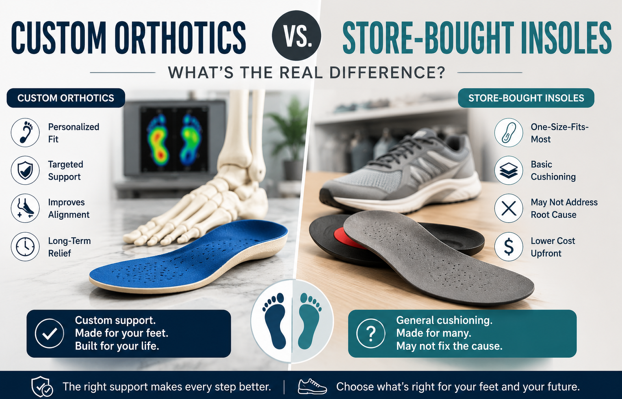
Most of us might have bought a pair of insoles, placed them in shoes, and waited for satisfaction that didn’t show up. Not all foot issues respond to the same treatment. Many people are not aware of this until they’ve already paid for the treatment.
Custom Orthotics in Brampton clinics provide a better beginning point. Before you purchase another pair based on your guesswork, let’s investigate the main differences between custom orthotics and over-the-counter ones, and then find the one that best fits your foot, not only the price.
Not All Foot Pain Has the Same Cause
It’s easy to think foot pain is no big deal and that it will disappear with time. The reality is that the same kind of pain can have very different causes depending on the person.
It’s all down to mechanics, like flat feet, high arches, etc. There are times when it’s due to inflammation or an injury from the past that hasn’t fully healed, or the way a person’s walking weight fluctuates. Two individuals can experience identical aches and require totally different methods of foot pain relief.
And here’s where it gets tricky: the symptom rarely tells the whole story on its own.
- A dull ache in the arch might mean you need better flat feet support, or it could be tendon strain, which is a different issue entirely.
- Heel pain relief sometimes just needs more cushioning, but other times the real problem is how your foot strikes the ground with each step.
- That “just tired feet” feeling can actually be an early sign of biomechanical foot issues quietly building up over months.
Guess at a solution without understanding the cause, and you usually end up with wasted money and the same frustration you started with.
See also: Balancing Techniques That Extend Equipment Life
Understanding Store-Bought Insoles and Where They Work Best
Over-the-counter, or store-bought insoles, are the mass-produced inserts you’ll find at almost any pharmacy, shoe store, or sporting goods shop. They’re sorted by shoe size rather than foot shape, which tells you a lot about how they’re made.
They’re designed for a wide variety of users, but not for any particular foot. This isn’t a problem; however, it means that they’re more suitable for certain situations than other situations.
Benefits You May Notice
There’s a reason these are still the first thing most people reach for:
- You can pick them up the same day, no appointment needed
- They cost a lot less upfront than a custom option
- Many add a noticeable layer of cushioning for tired or achy feet
- For mild, occasional discomfort, they’re often a perfectly reasonable place to start
Their Limitations
That said, there are trade-offs worth knowing about before you commit:
- The sizing is generic, not shaped around your actual foot
- The cushioning wears down faster than you’d think, often within a few months
- They tend to mask the symptom rather than fix what’s causing it
If the pain isn’t too severe, it is a good idea to invest in a pair of arch support insoles. But if the discomfort persists regardless of the remedy, it is usually an indication that there’s something more serious.
What Makes Custom Orthotics Different?
Custom orthotics aren’t simply a fancier version of the same product. They come out of an entirely different process: one that starts with your feet specifically, not some average shape pulled from a mold.
The Assessment Process
A proper fitting usually involves a qualified foot care professional looking at a handful of things together, not in isolation:
- A hands-on physical foot examination
- An analysis of how you actually walk
- Pressure distribution mapping across the sole
- A conversation about your daily routine, your footwear, and how active you are
That combination matters more than it might seem. Someone standing all day in a retail job needs something very different from a weekend runner, and an orthotic assessment is what accounts for that difference.
Designed Around Your Feet
Once the assessment wraps up, custom orthotic insoles are shaped to match your foot’s structure and the way you actually move. People typically notice:
- A fit that’s personalized to their foot, not a general size
- Comfort that holds up over the long term, not just the first few wears
- Better movement efficiency, since the support works with your stride instead of fighting it
For anyone who’s already tried the generic route without much luck, prescription orthotics or properly fitted custom shoe inserts are often a sensible next step, not some last-resort option.
When Should You Consider Professional Orthotic Care?
Treating mild, occasional discomfort on your own is completely reasonable. But there are a few signs that it’s time to bring in a professional rather than keep guessing.
It’s worth looking into orthotic therapy if you’re noticing any of the following:
- Pain that’s stuck around for weeks despite rest or new shoes
- The same injury showing up again and again in your foot, ankle, or knee
- Long hours on your feet for work
- Regular sports or high-impact training
- Diabetes or arthritis, where foot health needs a bit more attention
- Shoes that wear down unevenly on one side
None of this means there’s an emergency on your hands, but it does mean a proper look is worthwhile. Pedorthic care exists for exactly this in-between space, not urgent, but not something that’s going to fix itself either.
Which Option Fits Different Lifestyles?
There’s no single “right” answer between custom and store-bought. It really comes down to who’s wearing them and what their day actually looks like.
- Office workers suffering from minor, intermittent discomfort usually can get by on an effective store-bought solution.
- Healthcare workers, who work whole shifts walking, are more likely to benefit from a customized support system due to the strain that is repetitive.
- Retail employees, facing similar standing demands, often see better results from personalized foot support solutions too.
- Athletes who are dealing with lower limb alignment typically require orthotics that are adapted to the specific stride and sport they play.
- Seniors dealing with balance issues or joint wear can require a more thorough evaluation as opposed to the generic cushions.
- Patients who have chronic ailments that are ongoing, such as plantar fasciitis treatment, usually have more predictable results when using a customized approach.
The more challenging or repetitive an activity is, the more a personal match is likely to yield.
Choose the Solution That Supports Your Everyday Life
There’s no universal solution, but honestly, this is the most honest that anyone could ever tell you. Your decision is based on your foot’s anatomy as well as your everyday routine and the way your foot conditions have evolved over the years.
A little discomfort, if it occurs, can usually be cured by using a good insole from a store. If the pain persists and gets worse, it requires a thorough examination from an expert who is qualified to evaluate it.
If you’ve been guessing at solutions for a while without much to show for it, it may be worth talking to a Custom Orthotics in Brampton provider or checking our step-by-step guide to see how a proper fitting works, instead of leaving you to keep guessing on your own.
FAQs:
Qno 1 : Do I actually need orthotics, or am I overthinking this?
Honestly, if generic insoles haven’t helped after a few weeks and the pain’s still nagging you, that’s not overthinking; that’s your foot telling you something. Worth getting it looked at properly.
Qno 2 : Is the extra cost of custom orthotics really worth it?
Depends on you, really. Mild aches now and then, probably skip it for now. But if you’re on your feet all day or dealing with something structural, custom orthotics usually end up saving you money in the long term.
Qno 3 : Will orthotics fit into any pair of shoes I own?
Not always, no. It varies by shoe type, so when you go in for a fitting, bring up what you actually wear most. Otherwise, you might end up with something that only works in one pair.
Qno 4 : How many years should a pair of orthotics last me?
A few years if you take care of them. Wear and tear, how active you are, even changes in your feet over time- all of that affects how long they’ll hold up.
Qno 5 : So where do I even go to get fitted?
If you’re nearby, a Custom Orthotics in Brampton clinic is a good place to start. This isn’t really something you can order online and hope for the best; you need someone hands-on assessing your feet first.