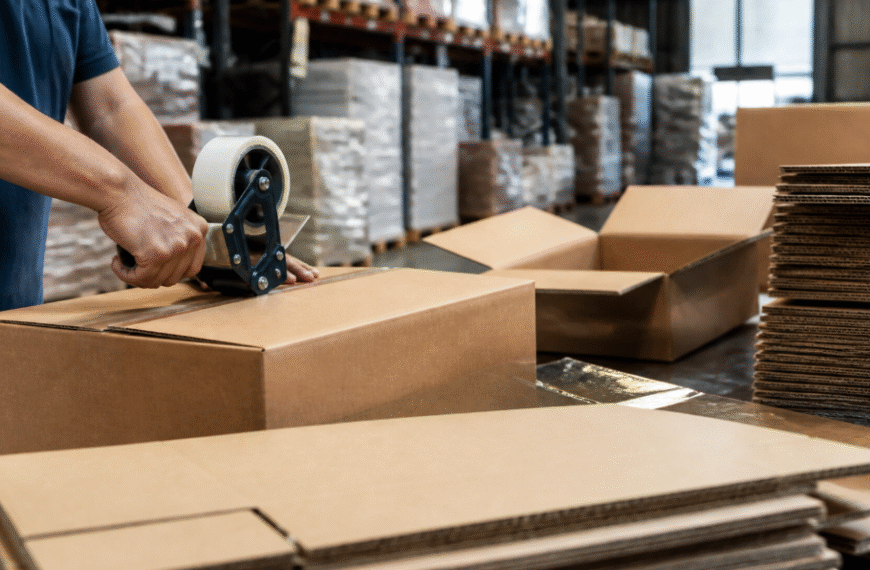
In a time when consumer expectations are rapidly increasing and operating margins are shrinking, packaging efficiency has risen up the priority list from a back-office concern to a board-level issue. From food and beverage, to pharmaceutical, personal care and beyond, manufacturers in every industry are feeling the pressure to do more with less. Faster turnaround, less waste, and more consistent output quality are no longer aspirational goals. In 2026, they are prerequisites for staying in the game in a cutthroat global market.
Growing Demand for Faster Packaging
Consumer buying habits are different now. The growth of e-commerce, the expectation of same-day delivery, and SKU proliferation have made manufacturers reconsider packaging line capacity across the board. Where once a single product format would dominate a production run, today’s lines must support frequent changeovers, smaller batch sizes, and an ever-growing variety of packaging formats.
Data from early 2026 on the global packaging market validates this transition — the automated packaging industry is expected to grow in value by more than 6% annually to reach the $75 billion mark by 2028. Much of this expansion is coming from food processing and consumer goods companies, which are investing heavily in flexible, high-speed machinery that can keep up with demand without matching increases in staffing.
Common Production Bottlenecks
Even with the high-tech machinery, many factories are still plagued by persistent inefficiencies. The most frequently reported bottlenecks are:
Manual sealing and filling processes — Although automated within larger facilities hand-packing is still common in small establishments and brings about variations in seal integrity, speed and weight of fill.
Film and Material Wastage — Inadequate tension control and old feeding systems are responsible for over consumption of film resulting in increase in the packaging cost per unit.
Unscheduled Downtime– When maintenance is reactive, the lines are down longer than they need to be. Industry surveys estimate that the cost of unplanned downtime to mid-sized manufacturers is roughly $50,000 per incident, accounting for labor, materials and order delay expenses.
Changeover Complexity — To changeover product formats or packaging sizes on legacy lines can be a matter of hours, cutting into the very time savings that automation is supposed to provide.
Addressing these bottlenecks not only involves new hardware, but a holistic approach to line layout and process integration. That’s where specialized solutions such as the vertical form fill seal machine come into play – providing a strong operational advantage by combining forming, filling and sealing in one integrated, automated process while addressing multiple such challenges at the same time.
Automation as a Competitive Advantage
The ones that have switched to automated packaging system always praise their KPIs got better. By comparison they experience huge boosts in throughput of 40% to 60% over manual versions and they see reductions in defect rates and material waste.
Robustness When well designed and controlled, manual operations can be very reliable. All units have the same dimensions and meet the same seal quality requirements and particularly in regulated industries this plays a vital role as packaging integrity is directly linked to product safety and compliance.
An unnoticed support is labour reallocation. Instead of simply eliminating jobs, many manufacturers are employing automation to enable workers to focus on more-valued activities—quality inspection, line supervision, process optimization—building a more skilled, engaged workforce in the process.
See also: Essential Steps to Launch Your Professional Business Successfully
What to Expect in 2026
This year, the packaging automation industry is witnessing a number of changes. AI driven vision systems are now common on mid-tier machinery allowing defect detection on the fly and without impacting line speeds. Sustainable engineering has led manufacturers to create machines that handle thinner, recycled and compostable films – the environment-friendly solution without compromising on performance.
Remote diagnostics and cloud-connected monitoring are no longer premium add-ons — enabled operators to access OEE (Overall Equipment Effectiveness) data remotely and to take preemptive action based on emerging issues, to mitigate potential downtime.
The new generation vertical form fill seal machine demonstrates these innovations with servo-based precision offering flexibility in material types and flawless system integration with ELAD production management systems plant-wide solutions.
Conclusion
Packing efficiency in 2026 isn’t just about getting product out the door faster. It’s about creating production systems that are flexible to change, intelligent to self-monitor, and efficient to sustain margins in a high-pressure process environment. Those manufacturers that are making smart automation a priority today are not simply addressing the throughput challenges of the moment, but rather laying the foundation of their operations for sustainable long-term growth.