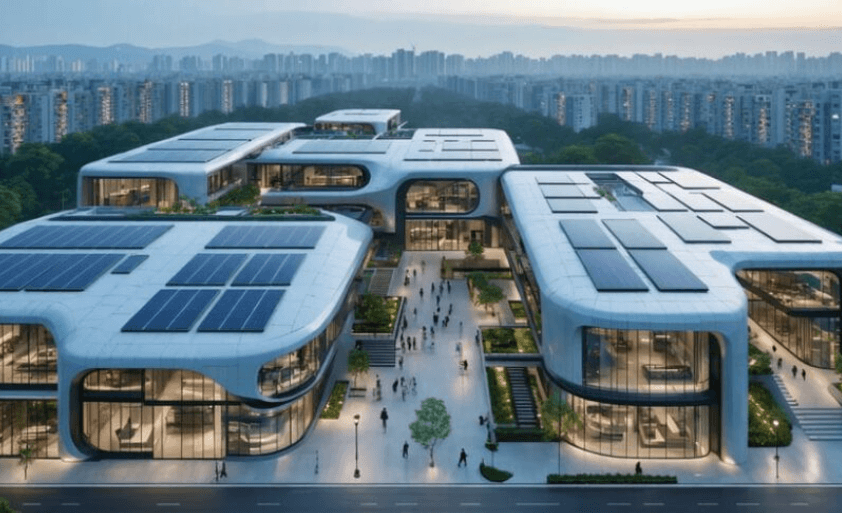
Building-integrated photovoltaic panels (BIPV) turn parts of your building—roofs, façades, and windows—into active electricity generators without adding separate arrays. You can cut energy bills and maintain design aesthetics by choosing BIPV products that replace conventional building materials while producing power.
Explore how different PV technologies and system components affect performance, cost, and appearance, and learn practical design and implementation strategies that fit new construction or retrofits. This article Building Integrated Photovoltaic Panels breaks down the core technologies, key components, and real-world design choices so you can evaluate whether BIPV makes sense for your project.
Core Technologies and System Components
This section identifies the main materials, integration methods, and electrical components that determine BIPV performance, durability, and architectural fit. You’ll learn which PV technologies deliver higher efficiency, how modules are integrated into roofs, façades, or glazing, and what inverters and balance-of-system elements you need for reliable operation.
Photovoltaic Materials and Efficiency
Choose PV materials based on efficiency, weight, translucency, and temperature behavior. Crystalline silicon (monocrystalline and multicrystalline) offers the highest cell efficiency (typically 18–24% for commercial modules) and strong long-term degradation profiles, but it is heavier and opaque.
Thin-film options (CIGS, CdTe, a-Si) provide lighter, flexible form factors and better low-light performance; typical efficiencies range 10–18%, with CIGS showing the best balance for BIPV.
Semi-transparent and bifacial technologies let you integrate PV into façades and glazing or capture reflected light from building surfaces.
Semi-transparent cells use patterned silicon or thin-film stacks to give visible transmittance while producing 30–70 W/m² less power than opaque panels at similar area. Bifacial modules increase energy yield by 5–30% depending on albedo and mounting.
Thermal performance matters: module temperature coefficients and ventilation behind mounted panels directly affect output.
You should check standardized degradation rates (e.g., ≤0.8%/yr) and fire, wind, and impact ratings for building code compliance.
Types of Integration Approaches
Integration approaches determine structural attachment, weatherproofing, and how PV replaces conventional materials. You can use roof-replacement BIPV (tiles, shingles), façade cladding (curtain wall panels), or glazed BIPV (windows, skylights).
Each approach has distinct mechanical loads and waterproofing requirements; roof replacements often require integrated flashing and load path design, while curtain-wall PV must meet façade deflection and fire separation standards.
Mounting methods vary: structural (modules act as primary envelope), semi-structural (modules mounted on a secondary support), and retrofit (modules attached to existing envelope).
Structural BIPV reduces material duplication but requires early-stage coordination with architects and structural engineers. Retrofit systems simplify installation but add dead loads and may need additional framing or rails.
You must consider orientation, tilt, and shading during design.
Daylighting, thermal comfort, and aesthetics influence module placement in glazed systems; specify g-values, U-values, and visible light transmittance when using BIPV glazing.
Electrical Systems and Inverters
Design the electrical system for safety, maximum yield, and maintainability. Core elements include DC collection (strings or distributed MPPT), inverters (string, central, or microinverters), and AC distribution with protective devices.
For complex façades or irregular orientations, use distributed MPPT via microinverters or power optimizers to reduce mismatch losses and improve per-module monitoring.
Choose inverters based on capacity and topology. String inverters suit uniform arrays and lower upfront cost. Central inverters fit large, centralized roofs. Microinverters provide module-level shutdown, simplified string design, and enhanced safety for vertical or multi-aspect BIPV arrays.
Include rapid shutdown, anti-islanding protection, AC/DC disconnects, and surge protection to meet grid codes and insurance requirements.
Balance-of-system items—junction boxes, wiring rated for UV and high temperatures, bypass diodes, and grounding—affect long-term reliability.
Plan access for maintenance, module replacement, and cleaning, and ensure electrical routing does not compromise the building envelope or fire compartmentation.
See also: How to Manage Business Documents Efficiently
Design and Implementation Strategies
You will balance appearance, system performance, and practical installation to make BIPV effective and reliable. Prioritize materials, orientation, and access for maintenance while meeting building codes and architectural goals.
Aesthetic and Architectural Considerations
You should select BIPV products that match façade materials and glazing proportions to preserve design intent. Use thin-film or colored crystalline modules when you need specific translucency or color; choose frameless or custom-sized modules to align with curtain-wall modules and window grids.
Coordinate with your architect and structural engineer early to integrate attachment details into the building envelope. Detail connections to manage thermal expansion, weatherproofing, and fire-stopping. Specify sightlines and module spacing to control visual rhythm and reflectance.
Use mock-ups and sample panels at scale to verify color, gloss, and light transmission under real lighting. Document the finish, edge detailing, and mounting reveals in the construction drawings so subcontractors reproduce the intended aesthetic.
Energy Output Optimization
You must optimize orientation, tilt, and shading to maximize annual energy yield for the site’s latitude and microclimate. Model expected hourly output with PV simulation software using local irradiance data, accounting for seasonal sun angles and nearby obstructions.
Choose module type and electrical configuration to match your inverter strategy and partial-shading behavior. Consider module stringing, microinverters, or power optimizers to reduce mismatch losses where façade sections receive uneven sun. Factor temperature coefficients and expected operating temperature of integrated assemblies.
Plan for system sizing relative to building load and grid interaction. Include buffer for soiling and degradation (typically 0.5–1%/yr). Specify monitoring at the array and sub-array level so you can detect underperforming zones quickly and validate production against modeled expectations.
Installation and Maintenance Best Practices
You should design mounting interfaces that separate waterproofing layers from PV attachments to avoid leaks. Use standardized mounting rails or bespoke clips that transfer loads to the structural backup, not the weather barrier. Detail air gaps and drainage paths to prevent moisture accumulation behind panels.
Write a maintenance plan that includes periodic inspection, cleaning intervals based on local soiling rates, and torque checks for mechanical fasteners. Provide replacement procedures for individual modules and electrical components to minimize disruption to the façade and building occupants.
Include accessible disconnects, labeled junction boxes, and clear as-built documentation. Train facilities staff on basic troubleshooting and supply a spare-parts list (modules, fuses, connectors) so you can restore service quickly after component failure.