Most maintenance reports blame the seal. A line starts hissing; someone traces it to a joint and replaces the O-ring or ferrule. Two weeks later, the same joint leaks again. The seal was rarely the problem. Across India, most persistent joint leaks in compressed air systems start at the thread, and buyers of pneumatic fittings in India often discover this only after the third or fourth repair. The thread carries the mechanical load, and it is also where most mistakes happen.
Here is why this matters more than it sounds. A joint that keeps reopening will eventually damage its port. Once a port boss cracks or the internal thread galls, you are no longer replacing a fitting; you are replacing a manifold or a cylinder end cap. That turns a small part into a plant repair. Anyone specifying pneumatic fittings in India for automation lines, packaging machines, or instrument air runs should treat thread selection as the first decision, not the last.
Thread Form Mismatch in Pneumatic Fittings
The single most common cause is a thread that almost fits. Three forms dominate Indian plants, and they are not interchangeable.
- BSPP, a parallel thread with a 55-degree form, sealing on a bonded washer or an O-ring at the face
- BSPT, a tapered thread with the same 55-degree form, sealing on the flanks
- NPT, a tapered thread with a 60-degree form and a different pitch
An NPT male will start into a BSPP port. It will take four or five turns. It will feel tight. It will also leak, because the flank angles never make full contact and the pitch diverges as the thread deepens. The joint holds air for a while on friction alone, then relaxes under vibration.
The tell is usually torque without resistance build-up. A correctly matched tapered thread gets progressively harder to turn. A mismatched one turns freely, then stops abruptly. The simplest field check is a thread gauge in every maintenance kit, which costs very little compared with a cracked valve body.
Stainless Steel Pneumatic Fittings and Thread Galling
Stainless steel solves corrosion problems but creates another. When two austenitic stainless parts of similar hardness are threaded together under load, the surface oxide film breaks down and the metal cold welds. The joint seizes partway in. Force it and the thread tears out.
This shows up more often on 316 against 316, which is exactly the pairing you want on coastal plants and washdown lines. A few practical controls help:
- Assemble slowly, since heat from fast driving raises the risk.
- Apply a suitable anti-seize or a PTFE-based lubricant to male threads.
- Pair components of different hardness where the design allows it
- Clean threads before assembly, because grit accelerates the damage
Galling is not a manufacturing defect, though it gets reported as one. It is a material behavior, and it is predictable enough to design around.
Torque Limits on Tapered Pneumatic Fittings
Tapered threads tempt people to keep turning. More turns, tighter seal, less air escaping. That logic damages ports.
A tapered male thread acts as a wedge inside the port. Every extra turn expands the female boss from the inside. Aluminum and brass bosses yield before the fitting does. Cast housings crack, sometimes immediately, sometimes three months later when thermal cycling finishes the job.
Follow the turns past finger-tight that the fitting maker specifies, usually stated as TFFT, rather than tightening by feel. Two engineers tightening by feel will produce two different joints, and neither will match the one made last year.
See also: How to Manage Business Documents Efficiently
Thread Sealant Choices for Air Lines
Sealant is where good assemblies quietly go wrong. PTFE tape wrapped past the first thread sheds fragments into the airstream. Those fragments travel downstream and lodge in flow control regulators, check valves and directional valves, where they sit as intermittent faults nobody can trace.
Anaerobic liquid sealants stay where you put them and suit most air service. If tape is plant policy, start the wrap two threads back from the leading edge and wrap in the direction of thread rotation. Never use sealant on a BSPP joint. That thread seals at the face, and sealant on the flanks lifts the washer off its seat.
Specifying Pneumatic Fittings for Indian Plants
Thread form comes first, then material, then size. Get the order wrong, and the rest stops mattering. Ask your supplier which thread standards a product line is cut to, whether both parallel and tapered options exist in the sizes you run, and what material pairings they recommend for your environment.
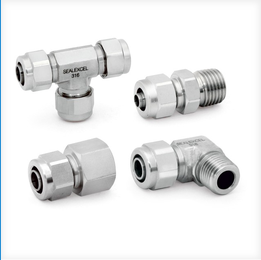
Sealexcel manufactures stainless steel push-in and push-on fittings, precision pipe fittings, flow control regulators, quick exhaust valves, pneumatic check valves, quick-connect couplings, needle valves, and 2/3-way ball valves from its Mumbai facilities. Visit https://sealexcel.com/pneumatic-fittings/ to review the range or send a specification for review.