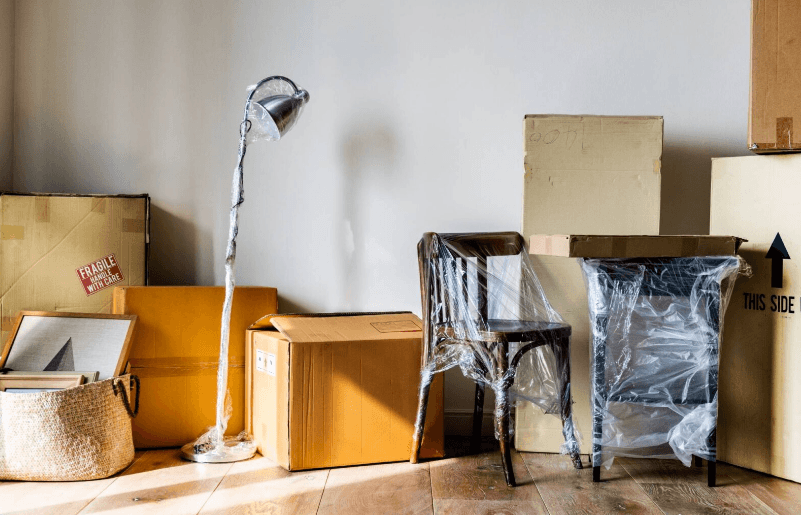
What does a sofa actually cost you if you own it for seven months and then sell it in a hurry? I have answered that question twice, both times in a parking lot behind a rented room in Erie, both times for less than I wanted to admit. I work the backstretch at a Pennsylvania track. Seven months on at the meet, five months gone, and everything I keep has to fit a truck bed and two duffel bags. After the second season I went through the receipts and worked out that a term rental, the kind of rent to own furniture pa agreement a local store will write, would have cost me less than owning and dumping the same furniture twice. That is the argument, and the arithmetic behind it is not complicated.
Seasonal Work Punishes Anything You Must Move
Anything you own has to be moved, stored, or sold, and on a seven-month meet none of those three is cheap. Storage in Erie ran me $65 a month for a unit barely bigger than a closet, which across five idle months is $325 spent to keep a sofa I paid $680 for. Moving it is worse. A one-way truck rental plus fuel is real money and a full day off the road, and the day is the part you feel. So most of us sell. What usually turns up in the last week of the meet is a group chat full of the same four items at the same collapsing prices, everybody unloading at once into a town of maybe thirty buyers who are also leaving.
The timing sets the price, and the timing is terrible. You are selling in the exact week every other seasonal worker is selling, to people who already own furniture, in a place that empties when the meet closes. A buyer who knows you leave Sunday is not bidding against anybody. I ate the loss twice before I sat down and did the math, which is two seasons longer than I should have taken.
What Two Seasons Of Resale Actually Returned
Season one, furnishing two rooms from nothing: a sofa at $680, a queen mattress and frame at $520, a dresser at $240, and a small dining table with two chairs at $180, so $1,620 gone before I owned a single plate. Seven months later the sofa went for $150, the dresser for $60, the table for $40, and the mattress went to the curb because nobody buys a used mattress from a stranger. That leaves $250 back on $1,620, and the truck I borrowed to haul the rest cost me $90 in fuel. One season of furniture comes to about $1,460 all in, which is roughly $208 a month for seven months of sitting down. Season two came to $1,310, and only because I bought cheaper things that fell apart faster.
Here is the part I cannot pin down. I do not know what the average seasonal worker recovers on resale, because nobody tracks it. No survey covers backstretch households, no agency publishes it, and every number I have heard quoted at the track was somebody remembering a good afternoon. What I can tell you is how to stop guessing about your own figures. Before you buy anything you already plan to resell, look the item up on Facebook Marketplace and pay attention to what is actually moving in your area rather than what people are asking, because the two are not close. That gap is the loss. Mine, averaged across both seasons, was about 84 percent of what I paid.
Questions I Should Have Put To A Store
In my third year I walked into a showroom with a written list, which was more preparation than I had managed in the two seasons before it combined. The staff worked through all of it in about ten minutes, and the answers were specific enough that I could hold two stores side by side and see a difference. Terms vary by company and by state, so nothing here is a promise about what any particular agreement says. Ask, then get the answer written on the contract rather than said across a desk.
- What happens if I return everything at the end of my season? A good answer names the notice required, any fee attached, and what closing the account leaves behind.
- What is the total I will have paid if I run this to ownership? A good answer is a printed dollar figure on the agreement, not a weekly rate you have to multiply yourself.
- Are delivery and pickup included, and what does same-week delivery cost? A good answer is a specific day and a specific number, stairs included.
- If I come back for next season, do I start fresh or pick up where I left off? A good answer explains exactly what carries over and what does not.
See also: Verified Support Hotline 0120535587 Reliable Business Contact
Hold The Term You Actually Live There
Renting the furniture for the months you are genuinely in town is not a fringe workaround anymore. A July 2026 Fortune Business Insights report projects the furniture and household goods rental market growing from $98.20 billion in 2026 to $219.83 billion by 2034, a compound annual rate of 10.60 percent. Plenty of that is students and corporate relocations rather than racing people, but the mechanics are the same ones I needed: pay for use while you are using it, hand it back when the room empties. Set against $208 a month of furniture I effectively destroyed, an agreement that ends when the meet ends does not have to be cheap to win. It only has to beat losing 84 cents on the dollar every autumn.
I typed rent to own furniture pa into my phone the week before this meet opened, drove forty minutes to a showroom, and had a bed and a sofa in the room before the first workout. Five months from now the furniture goes back and I head west with the same two duffel bags I arrived with. No parking lot sale, no group chat, no dresser sitting on a curb in the rain waiting for somebody to want it. Two seasons and about $2,770 bought me that lesson, and I would rather the next person coming up the shedrow got it for free.