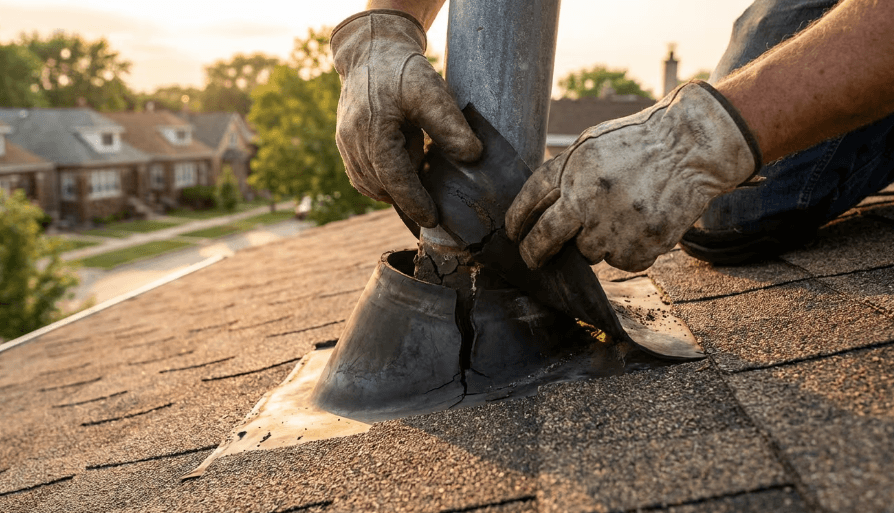
Three tarps, four tubs of roofing cement, roughly $180, and the water still found a way in. The only thing that changed was the room. It started over the hallway two winters ago and now it stains the guest room ceiling about four feet away, which is the tell nobody wants to read. This happens to careful people on single-story houses all over Temple. A leak has one entry point, and locating that point is the whole job a local roofing company temple tx does before it touches a single shingle. Here is the argument in plain terms. Patching from above across three seasons costs more money, and a good deal more risk, than paying once for a real diagnosis and repair.
Climbing Up Is the First Expensive Mistake
Start with the part that gets skipped. A wet roof is not a place to stand, and neither is a steep one, and neither is one a hailstorm worked over an hour ago. If you go up at all, the ladder needs level footing and three feet of extension above the eave, with somebody holding the base. In construction, OSHA requires fall protection any time a worker is exposed to a fall of 6 feet or more, and the agency reports that falls are the leading cause of construction deaths, about a third of them. Crews who do this daily wear a harness at that height. You are in sneakers holding a bucket. The ladder does not care how careful you feel. If you are not certain, stay on the ground and call somebody.
A Tarp Is a Deadline, Not a Repair
A tarp is a stopgap and nothing more. Every fastener driven to hold one down is a fresh hole in the roof, and UV breaks the plastic down through a Central Texas summer, so by August the thing protecting your decking is shedding into the gutters. Roofing cement follows the same arc on a smaller scale. It skins over, stays flexible a season or two, then cracks along the exact seam it was bridging, and water sits under a black patch where nobody can see it. Left long enough, that patch hides rot in the decking, which is a far bigger invoice than the original repair would have been.
Chasing the Drip Instead of the Entry Point
Water does not fall straight down through a roof. It runs along the underside of the decking, follows a rafter, drops off a nail head, and shows up on drywall well away from where it got in. Sealing directly above the stain relocates the leak instead of ending it. Job after job around Temple, the entry point turns up somewhere the homeowner never looked, usually at what roofers call step flashing, meaning the small L-shaped metal pieces woven into the shingle courses where a roof meets a wall or chimney. The other repeat offenders are cracked vent boots around plumbing stacks and the cut ends of shingle courses at a valley. A real inspection reads the attic side first, follows the staining back uphill, then goes onto the roof knowing what it is hunting for. That order matters more than any product on the shelf.
Adding Up Three Seasons of Roofing Cement
Put honest numbers on the do-it-yourself route. Three tarps at $34 each is $102, four tubs of roofing cement at $13 each is $52, and a box of cap nails plus a tube of sealant adds another $26, so materials alone hit $180 across three attempts. Add $28 to rent a twenty-four foot extension ladder if you do not own one, and the running total comes to $208 with the leak still live. None of that money bought a diagnosis.
Materials are not getting cheaper while you wait, either. The Associated General Contractors of America reported in its December 2025 producer price index that aluminum mill shapes had climbed 30.5 percent over the year on the back of tariffs, and aluminum is what most drip edge and flashing is made from. Putting the real repair off another year means buying that metal at next year’s price, with a season of water damage layered underneath it.
See also: How You Can Tackle A Complex Personal Statement For Admission To Law University In The Uk
Knowing Which Repairs Are Worth Calling In
A homeowner can genuinely handle a few things from the ground. Clear the gutters and cut back the limb that keeps sweeping the ridge. A flashlight in the attic after a hard rain also tells you more than an hour on the roof will. Anything past that, meaning lifting shingles, reworking flashing, or standing on a slope, belongs to someone with fall gear and a ladder they use every day. For a flashing repair on a single-story house, say $350 and a morning. Honestly, closer to $500 once a couple of shingle courses have to come off and go back on properly. Either figure beats a fourth season of chasing the drip, which is why a local roofing company Temple TX homeowners can reach the same week is worth more than one more trip to the hardware store. Get the entry point found once, repaired once, and warrantied, and you get your Saturdays back.