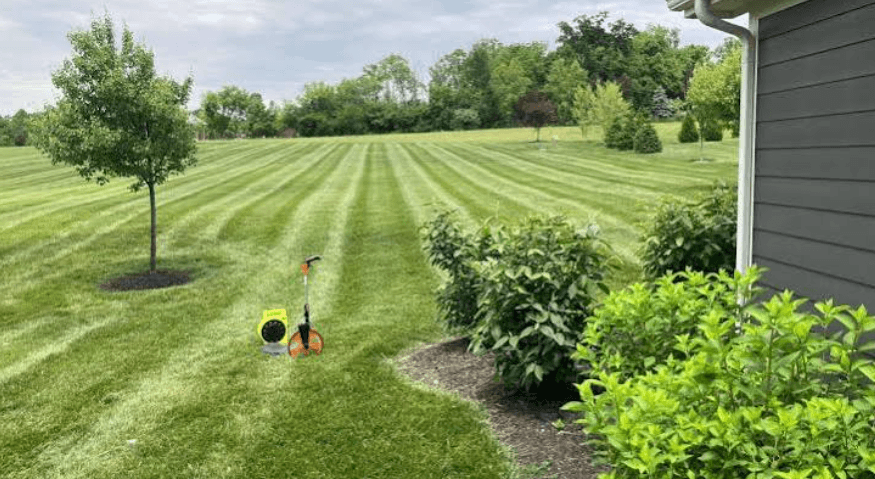
Six inches of rain over a weekend is an ordinary event in Montgomery County, and a flat backyard will sit under a good share of it for three or four days after the sky clears. By the third soggy morning the usual reflex is to price new sod, when the better call is a landscaper The Woodlands TX homeowners use for drainage work rather than another pallet of grass. Grass is rarely the problem. Eighty five years of statewide rainfall records, published in the peer reviewed Texas Water Journal in July 2026, put the wettest East Texas quadrangle at 54.8 inches of mean annual precipitation. The driest quadrangle out west averages 11.4 inches. Our yards are asked to move a great deal more water than a yard in Odessa.
Standing Water Is A Grading Problem First
Almost every soggy yard call comes down to slope. Builders here generally work to about six inches of fall in the first ten feet away from the foundation, and settling, bed edging and fifteen years of piled mulch quietly eat that fall until the ground tips the wrong way. What we see most often is a flower bed built up four or five inches proud of the lawn, holding runoff against the slab like the rim of a bathtub, with a downspout emptying straight into it. Nobody planned that. It accumulated.
Water does not negotiate. It runs to the low spot and waits there for the sun.
What To Ask Before Anyone Digs
A drainage bid is easy to compare on price and nearly impossible to compare on plan, so push the conversation toward the plan. Ask where the water is going, not just what is getting installed. A contractor who cannot walk you to the discharge point on your own lot is guessing, and guesses get buried under sod where you cannot inspect them.
- Where does this water discharge, and does that spot still drain during a storm? A good answer names a curb, swale or street inlet you can walk to together.
- What slope are you cutting into the swale? A good answer is a number, usually one to two percent, not a wave toward the back fence.
- What pipe diameter and fabric are you using, and why that size for my roof area? A good answer ties the size to how much water the roof and lot actually shed.
- Who comes back if water still stands after the next heavy rain? A good answer includes a follow up visit in writing, not a verbal promise.
Clay Soil Changes How Fast Water Leaves
Gulf Coast clay swells shut when it is saturated, so the ground stops accepting water at the exact moment you need it to absorb. Sand spread over clay usually builds a shallow bathtub instead of a sponge, which is how a cheerful weekend project makes year two worse than year one. On most jobs the working answer is a shallow swale carrying surface water, a French drain only where water genuinely collects, and beds raised with a real soil blend instead of another six inches of bark. Rain that falls on a monthly record of 34.6 inches, which is what August 2017 did to East Texas, is never going to soak in anywhere. The goal is moving it, politely and on purpose.
Those crawfish chimneys that show up in April are a decent tell that groundwater sits close to the surface, and if you have ever tried to photograph one before the neighborhood raccoons get to it, you know how that goes. Anyway, back to the drain. A yard with a high water table needs its outfall set higher and its swales wider, because a French drain sunk into permanently wet soil is just an expensive gravel trench that stays full.
Irrigation Clocks Waste Water After Storms
Any landscaper The Woodlands TX homeowners bring out should walk the property while it is actually raining, not three dry days later. Half the standing water we chase in July is not rain at all, it is a controller running four zones on a Tuesday schedule two days after a storm. Ten years ago the box in the garage was a dial timer wired to a rain sensor that nobody replaced when it quit, and the fix was remembering to shut the thing off before a front came through. A controller under $200 now pulls the local forecast and skips the cycle by itself, which makes it the cheapest drainage improvement on a lot of these properties. City officials in Phoenix estimated their park upgrades would save close to 81,000 gallons every time an irrigation cycle is skipped, as the trade magazine Irrigation and Lighting reported this summer. A quarter acre lot is nowhere near that scale, obviously, but the arithmetic runs the same direction.
What The First Year Actually Looks Like
The first week after a regrade the yard looks worse than the day you called, all tire ruts and stakes and bare orange soil. By week three the new turf has knit enough that a hard rain sheets across the surface instead of cutting a channel through it. Within 90 days the swale reads as a gentle dip nobody notices, the beds have settled, and the low corner that used to hold water for days drains in an afternoon. By month nine the only person who can still see the drainage work is the person who dug it, which is exactly the point.
See also: Planning a Texas Group Trip? When to Use a Charter Bus Rental
Fix The Water Before You Buy Plants
Plant selection is the fun part and it is also the part that fails first when the grade is wrong, because no drought tolerant native survives roots that sit in standing water twelve weeks a year. Spend the first dollars on slope, downspout extensions and a discharge point you can point at, then spend what is left on the planting plan. Done in that order, a Woodlands yard handles a six inch weekend without you thinking about it, and the sod you were about to buy stays where you put it.