Alt headline option: Your Robot Isn’t Broken. Your Training Data Is.
How real-world sensor data separates robots that work from robots that stall.
| TL;DR Most physical AI projects don’t break because the model is weak. They break because the AI training data never matched the real world. Sensor gaps, the sim-to-real gap, and unlabeled edge cases stop robots the second they leave the lab. The fix is real, varied, expertly labeled physical AI training data. Closing that gap is the reason Humyn Labs exists. |
| Why does physical AI fail without the right training data? Physical AI fails because a robot acts only on what it saw during training. The real world refuses to cooperate. Light shifts. Objects sit at odd angles. People move in ways no script predicts. Strip out diverse, sensor-rich, accurately labeled AI training data and the system misjudges depth, skips rare events, and stalls on the cases it never met. Better data solves this. A bigger model does not. |
The robot that couldn’t see a pallet
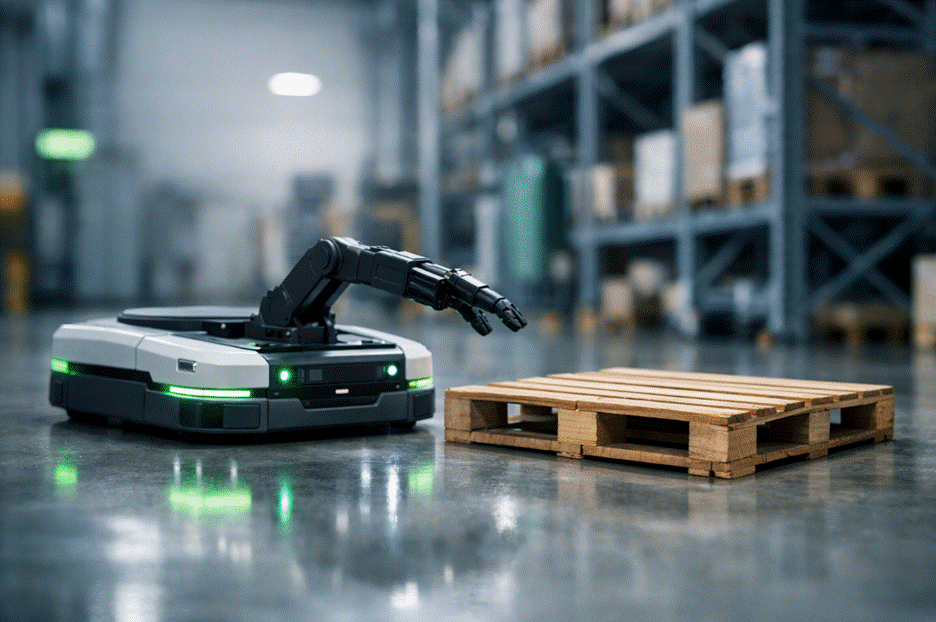
Picture a warehouse robot that crushed every lab test. It picked, placed, and rolled like a pro. Then it met the real floor. A pallet sat at an angle it had never trained on. Sun glanced off the wet concrete. The robot hesitated, then clipped the pallet and dropped the load.
No one shipped bad code that morning. The model worked fine. The trouble lived one layer beneath it, inside the data that taught the robot what the world looks like. That same story repeats across the industry right now. A team demos something slick, raises a round, then watches the system stall the moment it hits production.
Here’s the part teams learn the hard way. In physical AI, your model is only as smart as the AI training data feeding it. Nail the data and the robot adapts. Miss it and no amount of tuning will save you. This guide breaks down why physical AI and AI training data rise and fall together, what actually goes wrong, and how to fix it before it sinks a deployment.
What physical AI really means, and why data rules everything
Physical AI is AI that senses and acts in the real world. Robots, self-driving vehicles, drones, factory systems. They read their surroundings, reason, then move. A chatbot is a different animal. When a chatbot slips, you get a clumsy sentence. When physical AI slips, something tips, halts a line, or hurts a person.
That gap raises the bar on training data for AI. A digital model can absorb a small mistake. An embodied AI system pays for every blind spot in the physical world. So physical AI training data has to mirror the exact setting your machine will work in, right down to the sensors, the lighting, and the strange edge cases.
And the clock is ticking. Robotics investment jumped roughly 300 percent in the fourth quarter of 2025, and the global physical AI market, worth around USD 8 billion that year, will grow more than 30 percent a year through the next decade. Jensen Huang of NVIDIA called it the ChatGPT moment for robotics. But a quiet truth sits under the hype. All that hardware still needs real-world AI training data to function. The robots are ready. The data often isn’t.
The real reasons physical AI fails
When a deployment falls apart, the root cause almost always hides in the data pipeline. Five failure modes show up over and over.
1. The sim-to-real gap
Simulation is cheap and quick, so teams lean on it hard. But synthetic worlds skip the messy physics of the real one. Friction, glare, sensor noise, a smudge on the lens. A model raised mostly in a simulator dazzles on screen, then trips on the factory floor. The sim-to-real gap is the top reason a polished pilot collapses in production.
2. Sensor and modality blind spots
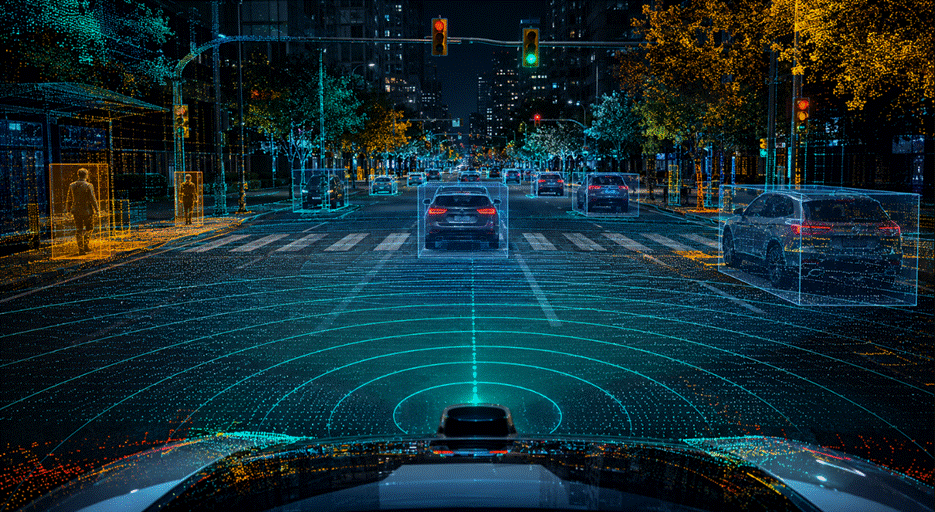
A robot reads the world through its sensors. Camera, radar, LiDAR, IMU, and more. If your AI training data leaves out a sensor the robot depends on, you’ve baked a blind spot straight into the model. Multi-sensor data has to be captured together and synced to the millisecond, or the robot sees a broken picture of reality.
3. Edge cases and the long tail
The common stuff is easy. The rare stuff wrecks you. A child darting into frame. A box mashed into a shape no one planned for. A reflection that fools the depth read. These long-tail moments rarely appear in off-the-shelf datasets, yet they trigger the failures that reach the news. Sound familiar? If your last pilot stumbled on something nobody saw coming, this is usually why. Strong physical AI training data chases these edge cases on purpose.
See also: verified corporate tech contact
4. Labeling errors and annotation drift
Bad labels teach bad lessons. One annotator boxes an object loosely, another boxes it tight, and the model learns confusion. At scale, that annotation drift quietly rots performance. For safety-critical work like self-driving, a careless label isn’t a typo. It’s a hazard.
5. Weak data diversity
Train a model on one warehouse, one climate, or one country, and it buckles the moment you move it. Real deployment spans geographies, weather, and conditions. If your training data for AI skips that range, the robot meets the real world as a stranger.
| The pattern Spot the theme. Every failure traces back to data that didn’t match reality. The model is rarely the villain here. The AI training data is. |
The hidden cost of bad training data
Cheap data feels like a win at the start. It rarely stays that way. A thin dataset resurfaces later as failed pilots, blown timelines, safety recalls, and lost trust with the enterprise buyer you chased for months. And fixing data after a field failure costs far more than getting it right at the source. Look at where the bill lands.
| Where you fix it | What it touches | Relative cost |
| Upstream, in the data | Collection and labeling plan | 1x |
| Mid-training | Retraining and re-labeling | 5x to 10x |
| In production | Recalls, downtime, lost deals | 50x and up |
The takeaway is blunt. Invest in physical AI training data early, or settle a much bigger bill later. Our overview of data quality assurance digs into how clean data drives the outcome.
How to get physical AI training data right
So how do you build AI training data that survives the real world? Run this five-step framework. We use a version of it on every project at Humyn Labs.
- Map your deployment reality first. Before you capture a single frame, write down the exact sensor stack, environments, and edge cases your robot will hit. Build the data around the pipeline, never the reverse.
- Capture sensor-rich, synced data. Collect across every modality your model uses, camera, radar, IMU, and beyond, and sync them tight. One coherent multi-sensor view beats a heap of disconnected feeds.
- Engineer for the long tail. Go hunt the rare scenarios deliberately. Blend targeted real-world collection with smart synthetic augmentation so the model meets the hard cases in training, not in production.
- Enforce annotation quality. Use multi-pass review and expert checks. One reviewer is a hope. Layered review is a standard. For safety-critical work, stack a domain expert on top.
- Close the loop after launch. Keep feeding real-world data back in. The world keeps shifting, and your training data for AI should keep learning alongside it.
That’s the exact model behind our physical AI data solution. We don’t just label what you send. We send verified field teams to capture multi-sensor data in the real settings your model needs to learn, then annotate it with 3D boxes, segmentation, tracking, and scene classification.

Synthetic data versus real-world data: what physical AI actually needs
People love to frame this as a fight. It isn’t. Synthetic data and real-world data each do a job.
Synthetic data wins on scale and on dangerous edge cases you can’t stage safely. Simulators spin up millions of scenario variations fast, and modern platforms hit strong sim-to-real transfer rates on benchmark tasks. Use it to bootstrap and to stress-test the rare stuff.
Real-world data earns its keep where it matters most: reliability and safety in production. The sim-to-real gap means simulation alone never fully captures real physics. Production-grade physical AI needs real sensor data to cross from demo to deployment.
Most strong teams land on a hybrid. Bootstrap in simulation, then ground the model in high-fidelity real-world AI training data before launch. That blend is where dependable physical AI and AI training data meet.
What you gain when you get it right
Strong data isn’t a cost center. It’s the thing that lets you ship. Here’s what shifts when your physical AI training data is built properly.
- A faster path from pilot to production. Fewer field surprises mean fewer rebuilds.
- Lower safety and liability risk. Expert-reviewed labels cut the errors that turn into incidents.
- Less rework. You retrain less when the data was right the first time.
- A real competitive moat. Proprietary, high-quality datasets are tough for rivals to copy.
- Enterprise and regulator trust. A full record of where the data came from makes audits painless.
How to choose a physical AI training data partner
Most annotation vendors only label data you already own. Physical AI asks for more. Run this checklist when you pick a partner.
- Real-world collection, not just labeling. Can they capture data in the field, or only annotate what you hand them?
- Multi-sensor fusion. Do they handle synced camera, radar, and IMU as one coherent dataset?
- Domain experts. Are their annotators verified in autonomy and robotics, or crowd workers learning on the job?
- Layered quality control. Peer review, centralized QC, and an expert layer for safety-critical work.
- Standard formats and a clear data trail. KITTI, nuScenes, Waymo, plus documentation you can defend.
Humyn Labs was built to clear every line on that list. Our annotators carry verified experience in autonomy, robotics, and spatial computing, with a tracked, tamper-proof reputation score that follows their skill over time. Every dataset passes peer review, centralized QC, and a domain expert layer for safety-critical use. See the workflow on our how it works page, or browse sample datasets and judge the quality yourself.
Who this is for and what to avoid
Search intent and audience
This guide is for the people who own the outcome. Robotics founders, ML and perception leads, autonomy engineers, and product owners on industrial automation teams. You’re past the demo. You need physical AI training data that holds up against the real world.
Common mistakes to avoid
- Leaning on simulation alone and ignoring the sim-to-real gap.
- Buying generic off-the-shelf datasets that miss your sensors and edge cases.
- Treating annotation as a commodity instead of an expert task.
- Skipping the data trail, then failing an enterprise or safety audit.
- Collecting once and never closing the loop.
Your model is only as smart as the data behind it
The winners in physical AI won’t be the teams with the cleverest model. They’ll be the teams with the best AI training data. Quality compounds. Every well-captured edge case and every clean label makes the next deployment smoother and the moat wider.
So before you blame the model, study what taught it. Real, varied, expertly labeled physical AI training data is the line between a robot that demos and a robot that works.
| Ready to ground your model in real-world data? Tell Humyn Labs about your sensor stack and use case. We’ll scope a collection and annotation plan within 48 hours. Talk to us or get a data proposal. |
Frequently asked questions
What is physical AI training data?
Physical AI training data is real-world sensor data, like camera, radar, and IMU readings, used to train AI that works in the physical world. It powers self-driving vehicles, robots, drones, and factory automation, where a model has to perceive and act, not just generate text.
Why does physical AI fail without the right training data?
Because a robot only knows what it saw in training. Strip out diverse, sensor-rich, accurately labeled data and it misjudges depth, skips rare events, and stalls on edge cases. The fix is better AI training data, not a bigger model.
Can synthetic data replace real-world data for physical AI?
No. Synthetic data is great for scale and for dangerous edge cases, but the sim-to-real gap means it misses real physics. Production-grade physical AI needs real-world data to reach the reliability and safety deployment demands. A hybrid approach works best.
How much training data does a physical AI system need?
It depends on the task, the sensors, and how varied the setting is. Coverage matters more than raw volume. You need enough diversity to cover your real deployment conditions and edge cases, with clean labels all the way through.
What annotation formats should physical AI data come in?
Industry standards like KITTI, nuScenes, and Waymo Open Dataset format, plus custom schemas. Good datasets also ship calibration files, timestamp sync metadata, and a full data trail so you can defend them in an audit.
How is Humyn Labs different from other data providers?
Most vendors only label data you already have. Humyn Labs runs end-to-end real-world collection and annotation with verified domain experts, a tracked reputation system, and double-verified quality control. More on our physical AI data page.